
words + illustrations by Lisa Yakobi published in the October 2023 issue of the Florentine
2023
Before leaving New York, whenever I told anyone I was going to Florence, the inevitable response was, “I’m so jealous! My dream is to have a villa in Italy!”
I met someone who did it. He bought a castle in the Italian countryside, sight unseen, and a few months after moving in, he told me, he was so bored, he’d been considering throwing himself out the window. Then I heard of a student who also had trouble in paradise. He jumped off the Ponte Vecchio into the Arno river with a plan to end it all, but a street vendor dove in and rescued him.
I approach the elegant Loggia del Pesce, a fish market designed in the 1500s. It looks out of place here, and it is. Moved from its original location twice to the center of the city, too lovely to demolish, today the only fish that reside here are in the aquatic reliefs that top its arches. I glance at its beauty with… indifference.
What is wrong with me?
People think if you live in a beautiful place, you’ll be happy. I’ve just moved into a garret, tiny, white, with skylights in the most beautiful city in the world. I am here to devote myself to art, to finish painting My Visual Diary series and write, and I have begun. I ask myself, Isn’t this enough? A voice within says, “No!” Why? Am I tired of Italy? No, It’s something else. Worse.
Next to the loggia, I spot a waitress in front of a favorite pizzeria. Exquisitely thin, in shimmering black leather pants, with her long blond hair, button nose, and face of a saint, she is more striking than ever. Two young Italians walking beside me stop, riveted, and one of them murmurs the word you hear everywhere in Florence: “Bella.”
Beauty is the reason for everything in Italy; it’s the reason the ornate fish market is here, the reason the waitress is dressed in such astonishing attire, and the reason I’ve returned here too. But it was different in 1983…
1983 My Visual Diary

FIRST DAY
On my first morning in Florence, I waken to the sound of opera coming from my window. I look outside. Everything is too beautiful! I stay in my room and draw in My Visual Diary, a sketchbook that became a series of paintings.

ITALIAN COAT
I can’t believe my graduate program is in this magnificent villa! I will have the grandeur of a Medici princess. Actually, I won’t. The villa is for the administration. Our art studios are in the unheated stables.
It’s an excuse to splurge on a coat. I’m sure I’ve attained the height of Italian chic until my reflection in a shop window reveals a Little Red Riding Hood.

ON A QUEST
Fashionably dressed men call out “Ciao Bella!” and offer a ca!é or gelato. What I really need are clear directions to a laundromat.

CAPPUCCINO
When all else fails, it is time for a cappuccino. My plan is to be taken for an italiana, but as soon as I say “un cappuccino,” the baristas gleefully announce me as “Un’americana!”

PREGO, SIGNORINA
When I enter a shop, the clerks always greet me with “Prego, signorina”. I am willing to pray. Sometimes I get what I pray for, and sometimes not.
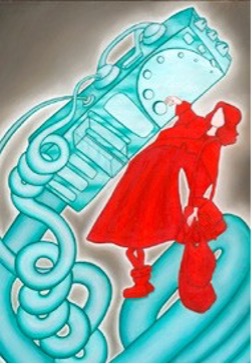
THE TELEPHONE
I push coins and gettoni into the phone in the bar, hoping I found the right slot. I tell the guy who asked me to call I can’t talk because it’s too noioso and find out later that means boring, not noisy! No wonder I never saw him again…
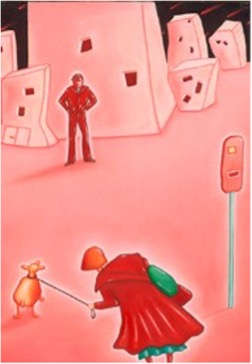
FIRST DATE
I meet another guy I like and plan to get all dressed up and impress him on our date, but I arrive home late with a lost dog and laundry in tow, and he is already at my door.
My parents’ weekly phone calls always begin with, “Well…” and a long pause (meaning Did you meet someone who is “marriage material” yet?).
After two years, in desperation, they buy me a ticket home and sign a lease on a Manhattan apartment. I return to New York, marry, and dream of Italy.
2023
Decades pass. Divorced, children grown, I head back to Florence at the age when they say women are invisible.
Now I see what’s wrong with me… It came to me in that moment by the loggia. I’m jealous! I’m not tired of Italy. I’m tired of being a spectator, of admiring things.
I want to be part of the picture, and admired too! I want to hear “bella” murmured about me! Not by a random Italian or on the street. I want to have a fling. Just one question: With whom? I haven’t a clue.
It’s really been a while, but there must be someone. One person does come to mind. No, impossible! We’ve been out of touch for years. I tell myself, forget it. Love will ruin your plans. Remember, you’re a signora now.
Don’t even think about it!
I take out my phone. I have a text. What? It can’t be! It’s him. He asks how I’m doing. I lie and say, “Okay”. I get an idea. I will invite him to visit me. No, I can’t do that! I hardly know him.
I do it anyway. He writes that he will come. In two weeks! Where will he stay? What if he doesn’t like me? What if I don’t like him? No matter. My heart is leaping as I take in all the beauty around me.
Not sure what’s wrong with you? Here’s the secret: follow your jealousy. Do that, and it will reveal your heart’s desire and lead you to the life and land of your dreams.
Share this:

 Lisa Yakobi